Papa Legba is often the first lwa people meet in Voodoo.
Known as the keeper of the gate and the messenger between humanity and the spirits, Papa Legba helps facilitate communication with the lwa. For many people, he is the welcoming presence who stands at the crossroads, greeting newcomers and helping them begin their spiritual journey.
Throughout the month of June, we will be honoring Papa Legba with teachings, special events, and opportunities to deepen your connection with this beloved lwa.
Here is what is coming up this month:
🔑 Papa Legba Monthly Ritual & Teaching Circle Join us on June 28, 2026 for our monthly Ritual and Teaching Circle dedicated to Papa Legba. Together we will explore his role in Voodoo, traditional ways of honoring him, and spend time in prayer and ritual.
🔑 Papa Legba Guided Readings We will be offering special Papa Legba Guided Readings during June. Details will be announced soon!
🔑 Learn More About Papa Legba If you would like to learn more about Papa Legba, visit: www.spellmaker.com/legba
🔑 25% Off Papa Legba Products Throughout June, enjoy 25% off selected Papa Legba items in our Etsy shop, including:
• Papa Legba Bath • Papa Legba Knock Knock Ritual Package
Whether you are meeting Papa Legba for the first time or have honored him for years, we hope you’ll join us as we celebrate the lwa who welcomes so many people to Voodoo.
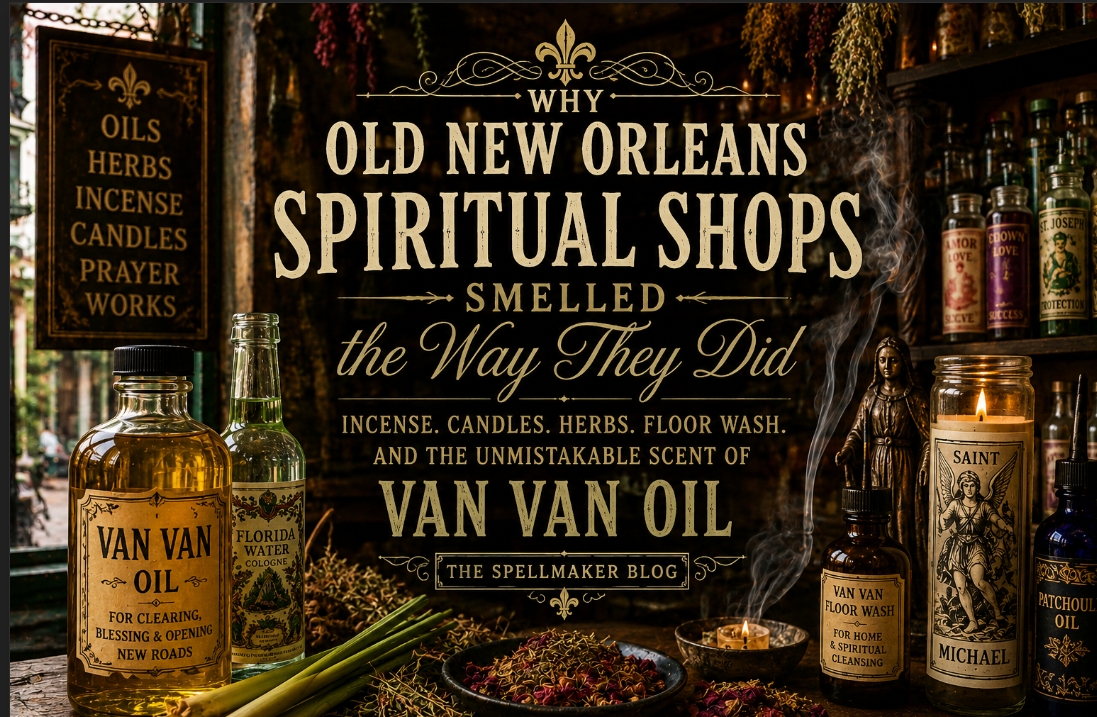
In the old spiritual shops of New Orleans, the scent hit you before anything else did.
Before you noticed the candles stacked floor to ceiling. Before you saw the jars of herbs, the shelves of oils, the prayer cards curling slightly at the edges, or the cat asleep beside the register. The smell arrived first, wrapping itself around you the moment the door opened.
It was impossible to mistake once you knew it.
Warm candle wax. Incense smoke. Old wood. Floor wash. Dried herbs. Florida Water. Dust from a hundred cardboard boxes. Faint tobacco. Perfume lingering in velvet curtains. Sometimes coffee brewing somewhere in the back. Sometimes rain drifting in through a cracked door from the New Orleans humidity outside.
And almost always, the bright lemony scent of Van Van oil moving through the air like sunlight.
For many people, Van Van oil became the smell of spiritual work itself.
Traditional Van Van formulas are usually built around lemongrass and citronella, often blended with other herbs and oils depending on the maker and family tradition. The scent is clean, sharp, green, and alive. It cuts through stale air immediately. In spiritual traditions throughout New Orleans and the South, Van Van is commonly associated with clearing negativity, opening roads, blessing new beginnings, and lifting heavy conditions.
In old spiritual shops, someone was almost always using it for something.
A worker dressing candles in the back room. A mop bucket prepared with a few drops added to the floor wash. Oils being blended behind the counter. A customer uncapping a bottle to smell it before buying. Sometimes it clung faintly to the hands of the shop owner after years of daily use.
The scent settled into the walls over time.
That layered atmosphere is part of what made those shops feel so different from ordinary stores. They did not smell manufactured or staged. They smelled lived in. Worked in. Prayed in.
The old wood floors absorbed decades of incense and oils. Herbs dried overhead from hooks and nails. Cardboard shipping boxes brought in dust from warehouses and ports. Glass bottles carried traces of rose, jasmine, patchouli, cinnamon, bay, and clove every time they were opened.
And then there were the candles.
Anyone who spent time in spiritual shops remembers the particular scent of warm wax and glass. Some candles carried heavy floral fragrances. Others smelled faintly medicinal or spicy from the oils being used to dress them. Burnt wick smoke mixed into everything, especially in shops where devotional lights stayed burning all day long.
That smell became comforting to many people. It meant someone was praying. Someone was working. Someone was trying to change their circumstances instead of surrendering to them.
In New Orleans especially, spiritual shops often reflected a blend of traditions rather than one rigid system. Catholic imagery stood beside African diasporic practices, folk remedies, lucky charms, roots, oils, incense, saints, and ancestor traditions. The scent of the shop reflected that blending too.
Rose incense might drift through the room while a bottle of Hoyt’s Cologne sat beside a statue of Saint Michael. Patchouli mingled with furniture polish and old books. Bay leaves and cinnamon bark rested in baskets near the counter. Somewhere, there was usually a faint trace of sulfur from incense or powders stored nearby.
Even the practical cleaning products became part of the spiritual atmosphere.
Many old Southern spiritual shops used strong floor washes with lemon, pine, camphor, or herbal blends. Cleanliness carried spiritual meaning. Washing the floors was not just housekeeping. It was often considered part of maintaining the energy of the space itself.
That combination of cleaning products, oils, herbs, and candle smoke created a scent profile you simply cannot recreate with one candle from a department store. It came from years of layering.
Years of prayers whispered over counters.
Years of herbs crushed between fingers.
Years of rainwater tracked in from New Orleans sidewalks.
Years of incense curling toward stained ceilings while customers quietly explained heartbreak, money troubles, court cases, illnesses, or impossible love affairs.
The shops themselves became memory keepers.
For many people, walking into one felt calming almost immediately, even if they could not explain why. The scent told your nervous system that this was a place where people came looking for hope. A place where candles were lit for the sick, the grieving, the lonely, and the desperate. A place where someone behind the counter might hand you a bottle of oil and say, “Baby, it’s going to be alright,” whether they fully knew your situation or not.
That atmosphere mattered.
Today, many modern metaphysical shops feel cleaner, brighter, and more polished. There is nothing wrong with that. But the old New Orleans spiritual shops carried a kind of beautiful clutter and warmth that is increasingly rare. They felt human. Imperfect. Alive.
And if you have ever walked into one of those old stores, truly old stores, you probably remember the smell even now.
The first spark of incense.
The warm wax.
The old wood.
And that unmistakable bright ribbon of Van Van oil cutting through the air like a blessing.
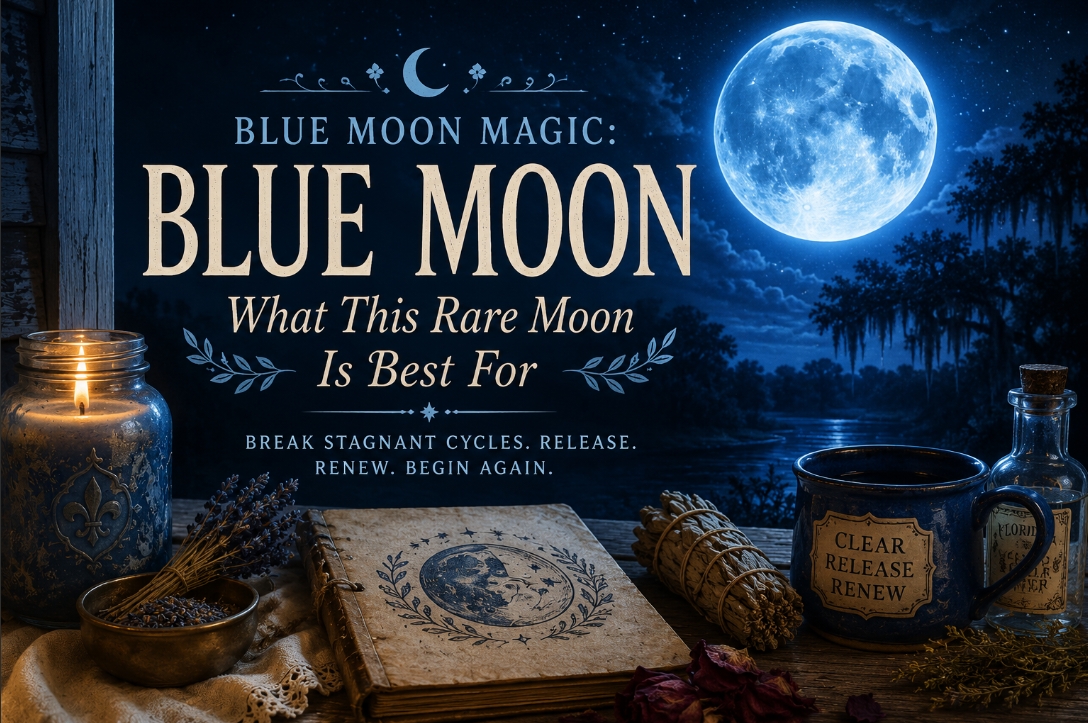
A Blue Moon has always carried a certain feeling around it. Even people who do not follow moon phases closely tend to pause when they hear the phrase. Part of that is rarity. A Blue Moon does not happen every month, and throughout history, unusual celestial events were often treated as spiritually significant. People noticed them. They watched the sky more carefully. They paid attention to dreams, emotions, and strange turns of fate during those nights.
Despite the name, a Blue Moon is not usually blue in color. The term most commonly refers to the second full moon occurring within a single calendar month. Because the lunar cycle does not line up perfectly with our modern calendar, this occasionally creates what feels like an “extra” moon. In folk traditions and spiritual practices, extra or unusual timing has often been associated with heightened energy, crossroads moments, and opportunities for change.
Many people believe Blue Moons carry a stronger emotional atmosphere than an ordinary full moon. There is often a sense of culmination around them, as though something unfinished has finally risen fully into view. Old feelings may resurface. Memories can feel vivid. Situations that have been dragging on for months sometimes suddenly reach a turning point.
Spiritually, Blue Moons are often considered especially powerful for breaking stagnant cycles. If you have felt stuck in the same emotional pattern, repeating the same arguments, struggling with the same fears, or circling the same unresolved situation, this moon is traditionally seen as a strong time to begin shifting that energy. In folk magic, repetition builds power, but unhealthy repetition can also create spiritual heaviness. A Blue Moon is often viewed as a chance to interrupt those patterns and move in a new direction.
This is also considered a good moon for releasing emotional clutter that has quietly accumulated over time. Full moons already carry associations with release and completion, but the Blue Moon’s rarity adds an extra layer of intensity. Many people use this moon to finally let go of lingering resentment, unhealthy attachments, self-defeating habits, or situations that have drained their peace for too long.
That does not always mean dramatic endings. Sometimes release happens quietly. It may look like deciding not to answer a message that would normally pull you into conflict. It may look like finally cleaning out a room that has carried stagnant memories. It may simply mean recognizing that your energy deserves to move toward something healthier.
Blue Moons are also associated with second chances and unfinished goals. In some traditions, they are viewed almost like a spiritual “extra page” in the cycle. If there is something meaningful you abandoned earlier in the year, this moon may feel like an invitation to revisit it with fresh eyes. Creative projects, spiritual practices, personal goals, and even relationships sometimes reappear under Blue Moon energy in unexpected ways.
However, folk traditions generally caution against treating a Blue Moon like a magical shortcut. Rare moons were respected precisely because they were believed to amplify what already existed beneath the surface. If a situation is unstable, emotional, or unhealthy, the energy surrounding a Blue Moon may intensify those feelings rather than magically erase them. In many old traditions, powerful moon nights were approached thoughtfully and with emotional honesty.
For spiritual cleansing work, the Blue Moon is often considered especially favorable. Cleansing baths, floor washes, house blessings, candle work, prayer, meditation, and spiritual uncrossing practices are all commonly associated with this kind of moon energy. Many people feel drawn to physically clean their environment during this time because the emotional symbolism feels so strong. Washing the floors, opening the windows, changing linens, or clearing clutter can become part of the spiritual process itself.
There is also a deeply emotional side to Blue Moon energy that should not be ignored. Some people feel unusually nostalgic during these moons. Others experience vivid dreams, restless sleep, heightened intuition, or sudden emotional clarity. Old relationships may briefly drift back into awareness, either through memory or actual contact. This does not always mean reconciliation is meant to happen. Sometimes it simply means the mind and spirit are sorting through unfinished emotional material before finally setting it down.
In Southern folk traditions especially, unusual moons were often treated as nights to pay close attention. People watched weather patterns, animal behavior, dreams, and emotional tension within the household. Rare celestial events were considered spiritually “loud,” meaning they could bring hidden matters closer to the surface.
Perhaps that is part of why Blue Moons still fascinate people now. Even in a modern world filled with constant noise and distraction, a rare moon still has the power to make people stop for a moment and look upward. It creates a feeling that time itself has briefly shifted sideways.
Whether you approach the Blue Moon through spirituality, folklore, prayer, reflection, or simple curiosity, it can serve as a meaningful pause point. A moment to ask yourself what has become too heavy to carry forward. A moment to reconsider what deserves another chance. A moment to clear space for the next chapter before it quietly begins unfolding beneath the next ordinary moon.
Long before moon phases became social media graphics and phone app notifications, people across the South watched the moon closely because they believed it mattered. Farmers, fishermen, rootworkers, midwives, grandmothers, and front porch storytellers all paid attention to the night sky. The moon was treated as part calendar, part warning sign, part spiritual clock.
Some of these beliefs came from European folklore carried into the South generations ago. Others blended with African, Caribbean, and Indigenous traditions over time. In many families, moon superstitions were simply accepted as common sense. You might not even be told where the belief came from. You just grew up hearing things like, “Don’t start that under a dark moon,” or “That full moon’s making folks act strange again.”
Whether taken literally or symbolically, moon folklore became deeply woven into Southern life.
One of the oldest Southern moon beliefs involves planting by the signs. Many farmers believed the moon affected growth much like tides and water movement. Crops that produced above the ground were often planted during a waxing moon, when the moon appeared to be growing brighter. Root crops were commonly planted during a waning moon, when the moon was shrinking.
Even people who were not especially spiritual often followed moon planting traditions because they believed generations of observation backed them up. Old almanacs printed moon charts for this very reason, and many Southern gardeners still quietly follow them today.
Another common superstition warned against beginning important work during the dark moon. The dark moon, the few nights before the new moon when the sky is at its blackest, was often associated with endings, uncertainty, hidden matters, and spiritual vulnerability. In some traditions, people avoided making major decisions, beginning relationships, or signing agreements during this phase.
At the same time, the dark moon was also considered powerful for cleansing and banishing work in folk magic traditions. Just because a moon phase was feared did not mean it was considered useless. Southern folk practices often viewed difficult energies as something to work with carefully rather than avoid entirely.
Full moons carried their own reputation for strange behavior and heightened emotions. Throughout the South, people long joked that hospitals, jails, bars, and emergency rooms became more chaotic during the full moon. Nurses, law enforcement officers, and night workers still swap full moon stories today with absolute conviction.
Whether scientifically measurable or not, many people genuinely feel that full moons intensify emotions. Old Southern sayings often linked the full moon to arguments, restless sleep, vivid dreams, impulsive decisions, and emotional tension rising to the surface.
Animals were also believed to behave differently during certain moon phases. Dogs howling, livestock acting nervous, owls calling repeatedly, or unusual nighttime activity sometimes carried spiritual meaning in folk belief. In rural areas especially, people paid close attention to animal behavior during unusual moons, eclipses, or major weather changes.
Weather folklore itself was deeply tied to the moon. One old Southern belief claimed that a ring around the moon meant rain or storms were coming soon. Another held that a clear, sharp winter moon predicted colder weather ahead. Some fishermen believed certain moon phases affected fish activity and tides strongly enough to determine whether a trip would succeed or fail.
Moon eclipses often carried especially uneasy reputations. In many traditions, eclipses were considered spiritually disruptive times when normal energies became unsettled. Some people avoided spellwork during eclipses altogether, while others believed eclipses amplified spiritual work dramatically and should be approached with caution and respect.
Blue moons and harvest moons developed their own folklore as well. Because they were rarer or visually dramatic, they became associated with omens, crossroads, and important turning points. A blue moon in particular often carried the feeling that something unusual was about to happen, which is part of why the phrase “once in a blue moon” became so tied to rarity and significance.
In Southern folk magic traditions, moon phases were often worked directly into candle practices and spiritual routines. People timed cleansing work, blessing candles, money spells, uncrossing rituals, and road opening prayers around lunar cycles. The moon was not viewed as separate from spiritual work. It was part of the rhythm of it.
A waxing moon was commonly associated with drawing things in: prosperity, love, opportunity, success, healing, or growth. A waning moon was more often linked to banishing negativity, ending unhealthy attachments, breaking bad habits, or removing crossed conditions. Full moons amplified energy. Dark moons quieted it.
Even today, many people who do not consider themselves especially superstitious still feel the emotional pull of certain moon nights. A bright full moon changes the atmosphere of a place. The world looks different under it. Sleep feels lighter. Thoughts drift differently. Old memories seem closer somehow.
That may be part of why moon folklore survives so stubbornly in the South. These beliefs were never only about superstition. They were also about observation, rhythm, memory, and the feeling that human life is connected to larger natural cycles moving quietly overhead.
In old Southern homes, people often lived closer to darkness, weather, animals, and the night sky than most modern life allows now. The moon was not hidden behind streetlights and screens. It was something people actually saw. Something they watched rise over fields, rivers, porches, and pine trees night after night.
And when something becomes part of daily life for generations, stories begin to gather around it like moths around a lantern.
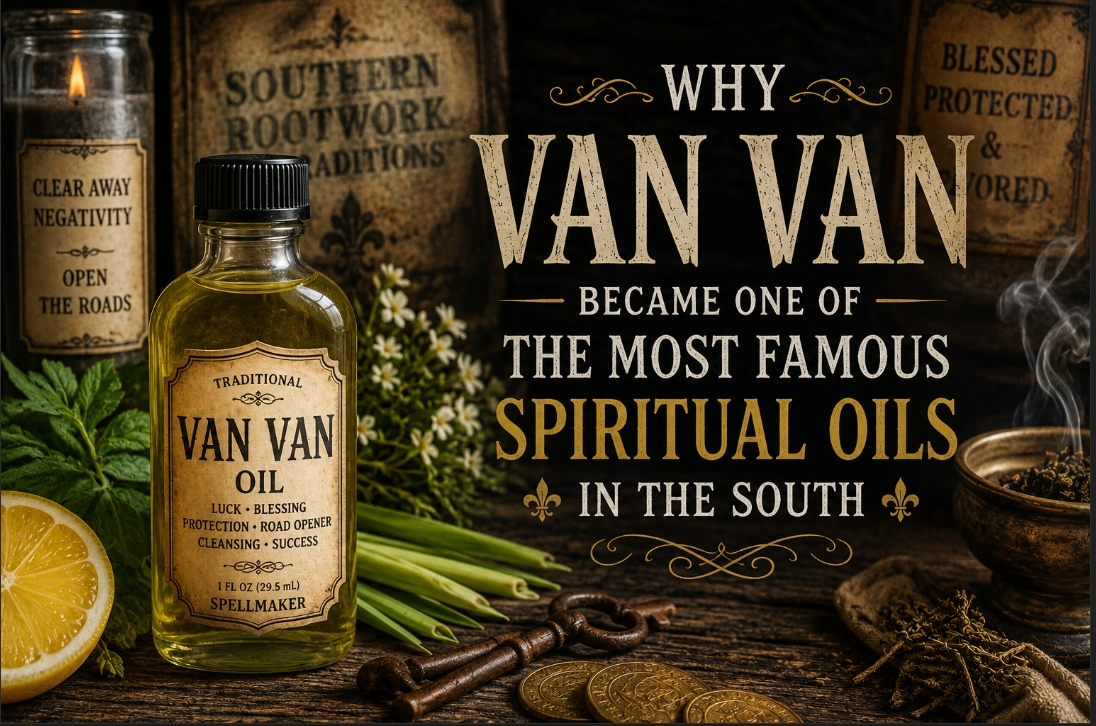
Van Van oil has one of the most recognizable scents in Southern spiritual traditions. The moment the bottle is opened, people who grew up around spiritual shops, candle services, rootwork, or old-style folk practices usually know exactly what it is. Bright lemon. Fresh herbs. A clean, green sharpness that somehow smells both comforting and powerful at the same time.
For generations, Van Van has been one of the most widely used spiritual oils in the South, especially in New Orleans spiritual traditions, folk magic, rootwork, and candle practices. While many condition oils are focused on one specific purpose, Van Van developed a reputation as something more versatile. It became known as an all-purpose spiritual helper, used for clearing away negativity, opening roads, changing luck, blessing new beginnings, and preparing the way for successful spellwork.
Part of Van Van’s popularity comes from its connection to cleansing and movement. In many spiritual traditions, stagnant energy is considered one of the biggest obstacles to progress. People become spiritually “stuck.” Homes feel heavy. Opportunities dry up. Arguments repeat themselves. Bad luck seems to linger like humidity in the walls.
Van Van became famous because it was believed to help shift those conditions.
Traditionally, Van Van oil was often used before beginning other spiritual work. Rather than jumping directly into money spells, love candles, or success rituals, many practitioners first focused on clearing away crossed conditions and opening the road ahead. In that sense, Van Van was often treated almost like spiritual preparation. A way of sweeping the path clean before moving forward.
Its history reflects the blending of many influences that shaped Southern spiritual traditions over time. Elements of African spiritual practices, European folk magic, Caribbean traditions, and Southern rootwork all helped shape the spiritual culture surrounding oils like Van Van. Over generations, these traditions mixed and evolved into something deeply regional and deeply personal.
The oil itself is traditionally associated with lemongrass, although recipes vary widely between makers and families. Lemongrass carries strong associations with cleansing, clarity, luck, and removing negativity in many spiritual systems. Its fresh citrus scent cuts through stale odors and heavy atmospheres quickly, which likely contributed to its reputation as a spiritual purifier.
In old Southern spiritual shops, the scent of Van Van was often everywhere. It lingered on candles, floors, prayer cards, incense smoke, and the hands of the people working behind the counters. Spiritual supplies were not treated like novelty products. They were used as practical tools for everyday problems. People came in looking for help with money troubles, difficult relationships, bad luck, court cases, illness, family conflict, and emotional burdens. Van Van became one of the oils people reached for again and again because it was believed to help clear away spiritual heaviness and bring movement back into a situation.
One reason Van Van endured while countless trendy spiritual products came and went is because it fits naturally into everyday life. It is not tied only to one type of spell or one narrow purpose. Traditionally, people dressed candles with it, added a few drops to floor washes, anointed doorways, dabbed it onto wallets or charms, used it during prayers, or applied it lightly before important meetings or difficult conversations.
Many people also associate Van Van with luck changing work. In Southern folk traditions, there has long been a belief that conditions can “turn.” Bad luck can shift. A difficult season can begin to break apart. Roads that seemed closed can slowly reopen. Van Van became strongly associated with that turning process.
That does not mean it was viewed as instant magic. Traditional practitioners usually understood spiritual work as something layered and ongoing. Cleansing the home, praying consistently, maintaining candles, washing floors, tending altars, and keeping faith during difficult times were all considered part of the process. Van Van was often used as a support within that larger spiritual framework.
Its scent may also explain part of its staying power. Certain smells become emotionally tied to memory and safety. For many people, the smell of Van Van recalls old spiritual shops with creaking wooden floors, walls lined with candles, and elders quietly giving advice across glass counters. It reminds people of watching a grandmother clean the house before sunrise, or seeing candles burning near prayer cards late at night while the rest of the house slept.
That emotional connection matters. Spiritual traditions survive because they become woven into daily life and memory. They stop being abstract ideas and become part of the atmosphere of home itself.
Today, Van Van remains one of the most respected and widely used spiritual oils in Southern folk magic and candle traditions. Despite changing trends online, its reputation has endured because people continue to return to the same core needs humans have always had: protection, blessing, movement, hope, and the desire for life to begin flowing in a better direction again.
At Spellmaker, Van Van continues to be one of the traditional oils people reach for when they feel spiritually stuck, emotionally weighed down, or ready to begin a new chapter. It is commonly used in candle work, spiritual cleansing, blessing rituals, and road opening practices throughout Southern folk traditions and New Orleans spiritual culture.
Some oils become popular for a season and disappear. Van Van stayed because generation after generation kept finding reasons to reach for the bottle again.
For generations across the American South, protection wasn’t always something dramatic or ceremonial. It often lived quietly in kitchens, gardens, aprons, and pantry shelves. Long before social media turned herbs into aesthetic bundles tied with twine, people were using what they had close at hand to guard the home, calm fear, and bring a sense of peace to everyday life.
Some of these traditions came from European folk practices, some from African spiritual systems carried through unimaginable hardship, some from Indigenous plant knowledge, and many blended together over time into what became Southern folk magic and home spirituality. In many families, these practices were never called “witchcraft” at all. They were simply things your grandmother did because that was how the house stayed protected.
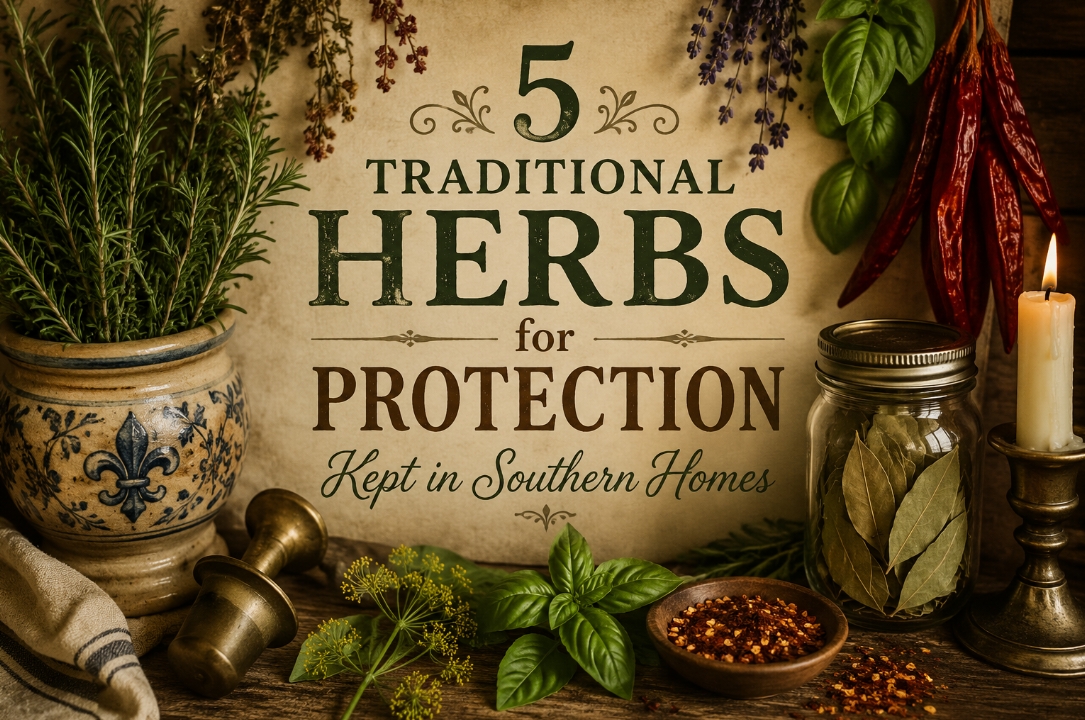
Here are five herbs that have long been associated with protection in Southern homes and folk traditions.
Rosemary is one of the best known protective herbs, and for good reason. People have tucked rosemary near doorways, burned it in the home, carried it in small sachets, and planted it by the front steps for centuries. In Southern folk traditions, rosemary is often connected to keeping away negativity while also bringing clarity and peace into the household.
One reason rosemary became so beloved is because it serves practical purposes alongside spiritual ones. It smells clean and comforting. It keeps well. It can be cooked with, brewed into rinses, or added to cleansing waters. In many homes, protection was never separated from ordinary life. The same rosemary used in supper might also be steeped into water for washing the front porch.
Rosemary is also associated with remembrance. Many people believe it helps strengthen the spirit during difficult times and offers emotional steadiness when life feels chaotic. Even the scent alone has a way of making a space feel calmer and more grounded.
Basil is another traditional herb that appears often in Southern spiritual practices. While many people think of basil as a prosperity or love herb, it has long been used for protection and blessing as well. Fresh basil near the doorway was sometimes believed to help keep harmful intentions away from the home while encouraging peace between the people living inside.
In some folk traditions, basil was added to floor washes or spiritual baths to help clear heavy emotional energy from a person or a room. A few fresh leaves tucked into a wallet, apron pocket, or kitchen corner were thought to bring comfort and stability.
There is something deeply home-centered about basil. It carries warmth rather than severity. Its protection feels less like building a wall and more like creating a healthy, living atmosphere where negativity struggles to take root.
Rue has a much sharper reputation. This herb has been associated with spiritual protection for hundreds of years across many cultures, including Southern folk traditions and forms of folk Catholicism. Rue is often connected with breaking negativity, turning away envy, and guarding against harmful intentions directed toward the household.
Many people planted rue near gates or walkways as a spiritual guardian. Others carried small pieces of it wrapped in cloth or added it to cleansing baths. Even today, rue remains one of the most commonly mentioned herbs in spiritual cleansing traditions throughout parts of the South and New Orleans folk practices.
Rue has a strong scent that some people love and others absolutely do not. That intensity may be part of why it became associated with powerful protection. It is not a soft herb. It has a reputation for standing watch.
At the same time, rue should always be handled carefully and respectfully, especially fresh rue, as it can irritate the skin for some people and should not be used casually around pets or children.
Bay leaves may seem humble, but they have long held a place in household protection traditions. In Southern homes, bay was often associated with blessing the household, guarding the kitchen, and strengthening intentions.
Some people tucked bay leaves above door frames or into pantry corners. Others wrote prayers or wishes onto dried bay leaves before burning them. Bay was also commonly included in cooking, which reflects something important about folk traditions in general: spiritual life was woven into ordinary routines rather than separated from them.
Protection was often built through repetition and care. Stirring soup. Sweeping the floor. Hanging herbs to dry near the stove. Lighting a candle at dusk. These small acts carried meaning.
Bay leaves also connect strongly to wisdom and clear thinking. In stressful times, they were sometimes used not just to protect the home from outside negativity but to help the people inside remain steady and sensible.
Red pepper has a fiercer reputation than many household herbs. In Southern folk practices, hot peppers and pepper flakes were often associated with driving away harmful influences and creating spiritual boundaries. Some traditions used pepper around property lines or thresholds as a symbolic warning against negativity.
Unlike gentler herbs associated with comfort and peace, pepper carries heat and movement. It is often connected with action, strength, and forceful protection. In folk magic, ingredients with heat are frequently believed to “wake things up” spiritually.
That said, traditional Southern spiritual practices usually balanced fiercer protective ingredients with calmer ones. A peaceful home was considered just as important as a defended one. The goal was not constant spiritual warfare. The goal was safety, stability, and keeping harmful energy from settling into the household.
One of the most beautiful things about old Southern herb traditions is how ordinary they were. Protection did not always require elaborate rituals or expensive supplies. Sometimes it looked like herbs drying in the kitchen window, a porch being washed before sunrise, or a grandmother quietly placing rosemary by the front door without explaining why.
These practices remind us that spirituality often lives in the small things. In caring for the home. In preparing food. In tending the garden. In trying, however imperfectly, to create a place where peace can remain and trouble has a harder time getting through the door.
You walk into a place and immediately feel different.
Sometimes the feeling is comforting. Warm. Familiar. Like the air itself is wrapping around you gently. Other places feel heavy without obvious explanation. You may suddenly feel anxious, emotional, unsettled, or deeply aware that something about the atmosphere feels “off.”
Certain places seem to carry something invisible within them.
An imprint. An echo. A presence.
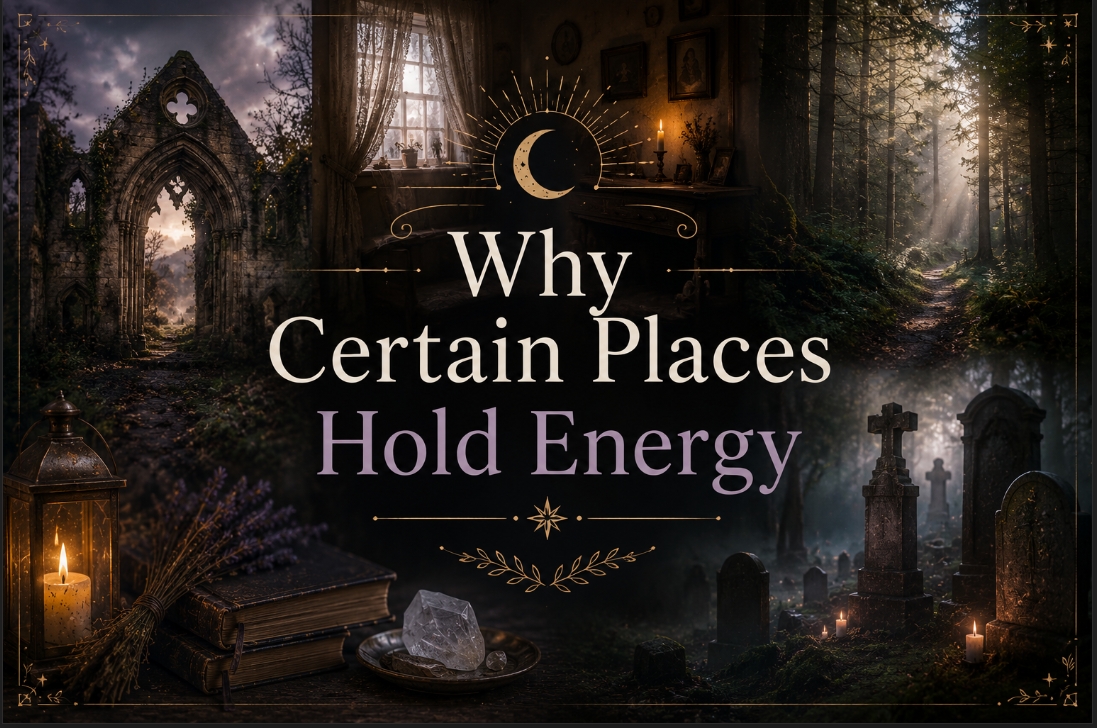
Across cultures and spiritual traditions, people have long believed that places can hold energy. Ancient temples, battlefields, churches, graveyards, forests, old homes, crossroads, hospitals, and even ordinary family kitchens have all been viewed as spaces where emotional or spiritual energy gathers over time.
Whether viewed spiritually, emotionally, or psychologically, many people instinctively sense that some places simply feel different than others.
Old homes are one of the most common examples.
Some houses feel immediately welcoming. Others feel tense or strangely quiet. People often describe certain rooms as “heavy” without fully understanding why. In spiritual traditions around the world, homes are believed to absorb emotional energy from the people who live within them. Years of laughter, grief, arguments, celebrations, illness, love, fear, and memory may leave behind an emotional atmosphere that sensitive people can still feel long afterward.
That does not necessarily mean ghosts are lurking behind every creaky staircase.
Sometimes places simply carry emotional residue.
Hospitals and nursing homes often affect people similarly. Even those who are not particularly spiritual frequently describe these places as emotionally intense. So much fear, hope, grief, relief, and transition passes through them that the atmosphere itself can feel emotionally charged.
Churches, temples, and sacred sites tend to feel different for another reason entirely.
For generations, people have prayed, mourned, celebrated, confessed, and sought comfort in these places. Repeated spiritual focus creates an atmosphere many people experience as peaceful, grounding, or deeply emotional. Even visitors who do not share the same beliefs often describe feeling unexpectedly moved within sacred spaces.
Nature holds energy too.
Forests, oceans, deserts, mountains, rivers, and caves have been considered spiritually powerful since ancient times. Certain natural places seem to quiet the mind almost immediately. Others feel wild and humbling, reminding people how small they truly are beneath the vastness of the world.
Forests especially appear often in folklore and spiritual traditions. They represent mystery, transformation, wisdom, danger, and healing all at once. Many people notice that their thoughts slow down in nature. Anxiety softens. The nervous system settles. It becomes easier to hear intuition beneath the noise of daily life.
Then there are places connected to personal memory.
A grandmother’s kitchen. A childhood bedroom. An old school hallway. A long-abandoned family home. The road where someone received life-changing news.
Places become tied to emotion very powerfully in the human mind. Returning to them can instantly awaken feelings that seemed long buried. Sometimes a single smell or shaft of afternoon light is enough to pull entire memories back to the surface like old photographs rising from water.
Crossroads have also held spiritual significance in many traditions for centuries. Symbolically, they represent transition, choice, uncertainty, and encounters with the unknown. In folklore, crossroads were often viewed as places where the physical and spiritual worlds touched more closely.
Even modern cities have places people instinctively avoid or gravitate toward without fully understanding why.
A quiet bookstore that feels comforting. A certain road that feels unsettling at night. A diner that somehow feels frozen in time. An abandoned building that seems strangely watchful.
Human beings are deeply sensitive to atmosphere, even when logic struggles to explain it.
Of course, not every strange feeling is supernatural. Sometimes environmental factors influence emotions more than people realize. Lighting, architecture, smell, sound, memory, stress, and subconscious associations all affect how places feel to us.
But even with those explanations, many people still believe certain spaces hold something more.
Perhaps places remember.
Perhaps human emotion leaves traces behind in ways science does not fully understand yet.
Or perhaps people simply carry pieces of themselves into every place they touch, quietly shaping the atmosphere around them over time.
Whatever the explanation may be, most people know the feeling when they encounter it.
A hush falling over a room. A sudden stillness. The strange sensation that a place is somehow alive with memory.
Long before self-help books, motivational podcasts, and endless social media advice, people turned to smaller things for comfort.
A pinch of salt tossed over the shoulder. A wish made on the first evening star. Knocking on wood after speaking too confidently about the future. Keeping a lucky coin tucked away in a pocket or purse.
Superstitions have existed in nearly every culture throughout human history. Some were meant to protect against bad luck. Others invited blessings, prosperity, love, or safety. Many began in times when life felt uncertain and frightening, giving people small rituals that made the world feel a little less chaotic.
And even now, in the middle of modern life with smartphones and streaming services and grocery pickup apps, many of those old habits still remain.
Not because people are foolish.
Because human beings have always searched for comfort, meaning, and reassurance.
One of the oldest and most widespread superstitions involves throwing spilled salt over the left shoulder. In many traditions, salt was seen as protective and purifying. Spilling it was considered unlucky, and tossing a pinch behind you was believed to ward off negativity or bad fortune lurking nearby.
Even people who laugh while doing it often still do it anyway.
Just in case.
Knocking on wood is another superstition that has survived centuries. Historians believe it may trace back to ancient beliefs that spirits lived within trees. Touching wood after speaking of good fortune was thought to prevent jealousy from spirits or fate itself.
Today, people still instinctively rap their knuckles against a table after saying things like: “I haven’t been sick all year.” “My car has been running perfectly.” “Things are finally calming down.”
It is part habit. Part humor. Part tiny prayer hidden inside ordinary conversation.
Wishing on stars also continues to comfort people in quiet ways. There is something deeply human about looking up into the night sky and attaching hope to a distant point of light. For centuries, people believed stars carried spiritual significance and that wishes spoken beneath them traveled farther into the unseen world.
Even now, adults who insist they “do not believe in that stuff” still sometimes pause when they see a shooting star.
And for one small moment, they hope.
Many superstitions center around protection of the home.
Horseshoes above doorways. Brooms placed near entrances. Salt across thresholds. Protective herbs hanging in kitchens. Keeping windows cracked during funerals so spirits could leave peacefully.
These traditions often blurred the line between spirituality, folklore, and practical comfort. A protected home felt safer emotionally as well as spiritually.
Some superstitions revolve around animals.
Black cats remain one of the most famous examples. Depending on the culture, they were seen either as omens of bad luck or symbols of protection and magic. Crows and ravens were associated with prophecy, wisdom, or messages from the spirit world. Crickets inside the home were sometimes considered signs of good fortune.
Birds at windows still unsettle many people today, especially after loss or during periods of emotional upheaval.
Then there are the deeply personal superstitions people create for themselves over time.
A “lucky” sweater worn during difficult situations. A certain song that always seems to play before good news. A necklace worn for comfort. A routine repeated before traveling. A candle lit during stressful times.
These small rituals become emotional anchors.
And perhaps that is why old superstitions endure even in modern times. Beneath the folklore and symbolism, many of them offer something people desperately need: A sense of control. A sense of connection. A sense that the world may contain hidden meaning after all.
Superstitions also connect us to the generations that came before us.
A grandmother teaching a child never to open an umbrella indoors. A parent quietly making the sign of the cross while driving through storms. A family repeating the same New Year traditions decade after decade.
These small acts become threads stretching across time.
Not every superstition needs to be taken literally to hold value.
Sometimes the comfort itself is the magic.
Sometimes the ritual matters more than whether the universe truly keeps score of spilled salt and broken mirrors.
And in uncertain times especially, people often return instinctively to small comforting traditions that make life feel warmer, safer, and more connected.
A candle in the window. A wish whispered into darkness. A lucky charm tucked into a pocket. Knuckles tapping softly against wood after speaking hope out loud.
Tiny rituals.
Tiny comforts.
Tiny ways human beings remind themselves that perhaps the world still holds a little mystery after all.
One of the most common spiritual struggles people face is learning the difference between anxiety and intuition.
At first glance, the two can feel surprisingly similar.
Both create strong feelings. Both can arrive suddenly. Both can make your attention lock onto a person, situation, or decision until it becomes difficult to think about anything else.
But anxiety and intuition are not the same thing at all.
Learning to recognize the difference can bring enormous peace, especially for sensitive people who tend to absorb emotional energy very deeply.
Anxiety is loud.
Intuition is quiet.
That is often the simplest way to begin understanding the difference.
Anxiety tends to spiral. It repeats itself endlessly like a smoke alarm with dying batteries. It demands immediate action. It pushes urgency, fear, worst-case scenarios, and constant over-analysis.
“What if something terrible happens?” “What if I made the wrong choice?” “What if they leave?” “What if I fail?” “What if I missed a sign?”
Anxiety rarely brings clarity. Instead, it creates loops. The mind races in circles searching for certainty that never fully arrives.
Intuition feels very different.
Intuition is usually calm, direct, and surprisingly simple. It often arrives as a brief inner knowing before fear has time to interrupt it. Sometimes it is only a quiet feeling in the body. A pause. A pull. A sense that something is either right or wrong without being able to fully explain why.
Unlike anxiety, intuition does not usually scream.
It nudges.
Anxiety often feels frantic in the body as well. Tight chest. Racing thoughts. Restlessness. Compulsive checking. Difficulty relaxing. It feeds on repetition and tends to grow louder the more attention you give it.
Intuition usually feels steadier.
Even when intuition warns us about something difficult, it often carries a strange sense of clarity beneath it. The message itself may not be pleasant, but it does not feel chaotic. There is less emotional static attached to it.
For example, anxiety may say: “They hate me. Something is wrong. I need to text again right now.”
Intuition may quietly say: “This situation feels unhealthy for me.”
One spirals outward endlessly.
The other simply knows.
Another important difference is that anxiety is often rooted in fear of the future, while intuition exists very much in the present moment.
Anxiety tries to predict and control every possible outcome. It wants guarantees. It wants certainty. It wants absolute reassurance before allowing you to rest.
Intuition does not usually explain itself that thoroughly.
Sometimes intuition simply says: “Do not go there.” “Call this person.” “Wait.” “Pay attention.” “Something feels off.”
And then it becomes quiet again.
Many people struggle with intuition because they keep waiting for it to sound dramatic. They expect thunderbolts, visions, or unmistakable signs. But intuition is often subtle. The first whisper is usually the clearest one before fear and overthinking rush in to bury it under mental noise.
Modern life makes this even harder.
People today are overstimulated constantly. Phones buzzing. News alerts. Endless scrolling. Stress. Financial pressure. Emotional exhaustion. The nervous system rarely gets a chance to settle long enough for intuition to rise clearly to the surface.
When people are overwhelmed, anxiety can begin impersonating intuition.
A frightened nervous system cannot always interpret spiritual or emotional signals clearly.
One helpful exercise is to pause and ask yourself: “Does this feeling bring clarity or confusion?”
Anxiety usually creates confusion.
Intuition usually creates clarity, even if the answer is uncomfortable.
Another helpful question is: “Is this feeling growing louder because I keep feeding it?”
Anxiety feeds on attention. The more we check, analyze, panic, and seek reassurance, the larger it becomes.
Intuition does not usually demand obsession.
It simply remains present until acknowledged.
This does not mean intuition is always perfect or that anxiety should be ignored completely. Anxiety can sometimes alert us that something in our lives genuinely needs care or attention. But living in a constant state of fear makes it difficult to hear our deeper inner wisdom clearly.
Part of spiritual growth is learning how to become still enough to recognize your own inner voice again.
That takes patience.
And gentleness.
Not every fearful thought is a prophecy. Not every coincidence is a sign. Not every feeling deserves immediate action.
Sometimes the most spiritual thing a person can do is pause, breathe, ground themselves, and listen carefully before reacting.
Intuition tends to arrive quietly.
Fear tends to pound on the door.
Learning the difference between the two can change your entire relationship with yourself.
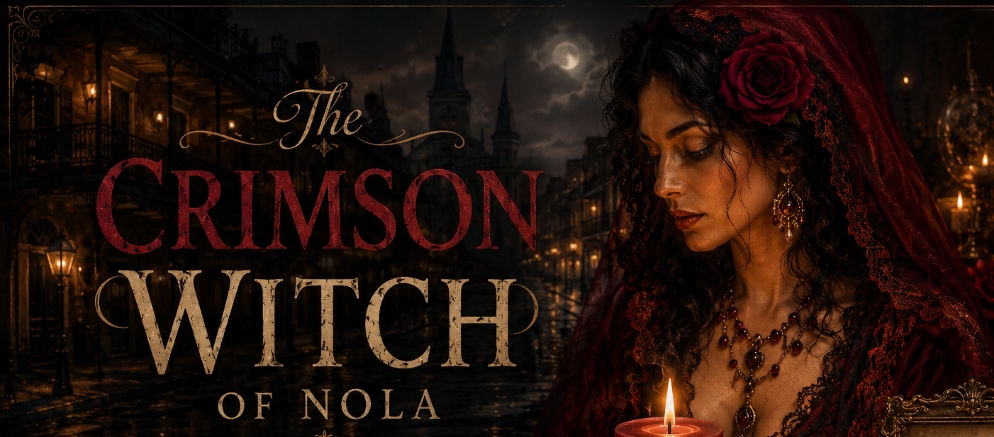
In the older parts of New Orleans, where iron balconies cast long shadows across narrow streets and the air still carries the memory of candle smoke and river water, there are stories that never fully disappear.
They survive quietly.
In family recollections. In passing conversation. In the way certain names are spoken softly, as though they still belong to the city itself.
One of those stories is about a woman known as the Crimson Witch.
No one agrees on her real name. Some said she was French. Others believed she was Creole. A few insisted she came from somewhere else entirely and simply chose to remain in New Orleans after tragedy changed the course of her life.
But while the details shifted over time, one thing remained consistent:
People came to her for matters of the heart.
Not in crowds or spectacle, but quietly, often in the evening after the streets had settled and the city softened into lamplight and music drifting through open windows.
They came with ordinary heartbreaks. Distance in a marriage. Love that had cooled. Loneliness. Fear of never being chosen. Relationships strained by misunderstandings and silence.
And according to the stories that survived, the Crimson Witch approached these situations differently than many others of her time.
She did not promise domination or control.
She did not claim to force love where none could exist.
Instead, her work focused on gentleness.
On softening tension. On encouraging affection. On clearing bitterness and allowing warmth to return where it had faded beneath hurt and exhaustion.
That distinction became the heart of her reputation.
Those who sought her out described her as patient and kind. She listened carefully before offering guidance. Her work centered around candles, oils, herbs, and quiet rituals meant to support connection rather than overpower it.
In modern terms, her approach might seem subtle.
At the time, it was simply understood as effective.
People returned to her not because they feared her, but because they felt calmer after leaving her home. Supported. Hopeful again.
And often, the changes came gradually.
A long-delayed conversation finally happened. A partner softened emotionally. A relationship that had grown cold slowly began warming again.
Not dramatic miracles.
Small human shifts that mattered deeply to the people living through them.
Over time, the story of the Crimson Witch became woven into the folklore of New Orleans itself. Though no formal records remain, elements of her methods continued quietly through generations. The belief that love responds better to care than force became part of the legacy associated with her name.
There is also a sadness woven through the legend.
Many versions of the story claim the Crimson Witch herself lost the great love of her life unexpectedly when she was still young. Some say he died in an accident near the river. Others say illness took him before they could marry.
Whether true or embroidered over time, the detail explains the tenderness associated with her work.
There is no bitterness in the stories about her. No cruelty. No hunger for power.
Only the sense of a woman who understood how fragile love could be and chose to help protect it where she could.
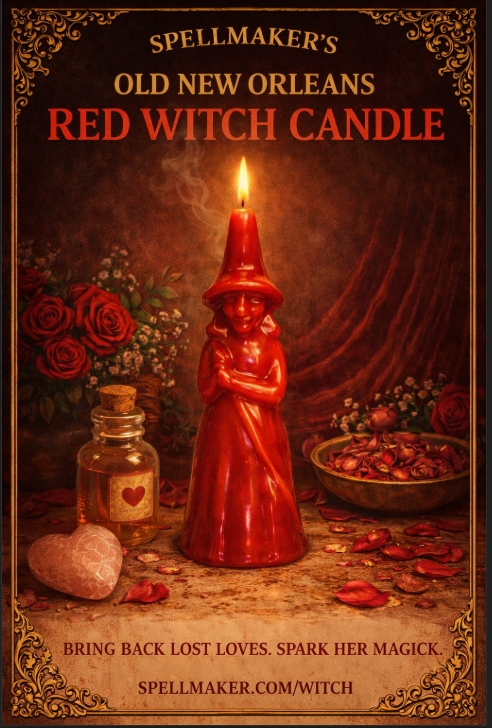
Created in honor of the Crimson Witch and the gentle style of love magic associated with her story, each Red Witch Candle is hand poured with care. The original mold itself was hand made by Parran Matt, giving the candle a unique connection to old-world craftsmanship and tradition.
The Red Witch Candle is intended for warmth, attraction, emotional closeness, reconciliation, and encouraging affection to grow naturally. Many people use it for rekindling existing relationships, while others burn it to draw new love into their lives in a softer, more organic way.
Like the woman who inspired it, the candle is not about force.
It is about invitation.
About creating space for love to breathe again.
Perhaps that is why the story of the Crimson Witch continues to endure while so many others fade away.
Because beneath the folklore, beneath the candlelight and whispered stories, there remains something deeply human at its center:
The hope that love, when treated gently, can still find its way home.